info@panaceai.com.au

Clinical calculators from published research

Three calculators, each built on a model described in a peer-reviewed paper. Each one takes findings from routine pathology, with a few clinical details such as age or stage, and returns an estimate of survival or risk for one patient.

MTCx

Medullary thyroid carcinoma

Estimates
Recurrence-free survival.
For
Clinicians caring for people with medullary thyroid carcinoma, a rare thyroid cancer.
Uses
Routine pathology findings, including mitotic count, Ki67, necrosis, lymphovascular invasion and margin, alongside stage. It builds on the International Medullary Thyroid Carcinoma Grading System.
Evidence
Developed on 300 patients from five centres across the USA, Europe and Australia (AUC 0.94, C-index 0.876), then tested on an independent cohort of 87 patients at Emory University, where the AUC was 0.90. External validation so far rests on this one centre.

Open the calculator: MTCx panacea.shinyapps.io/MTCx
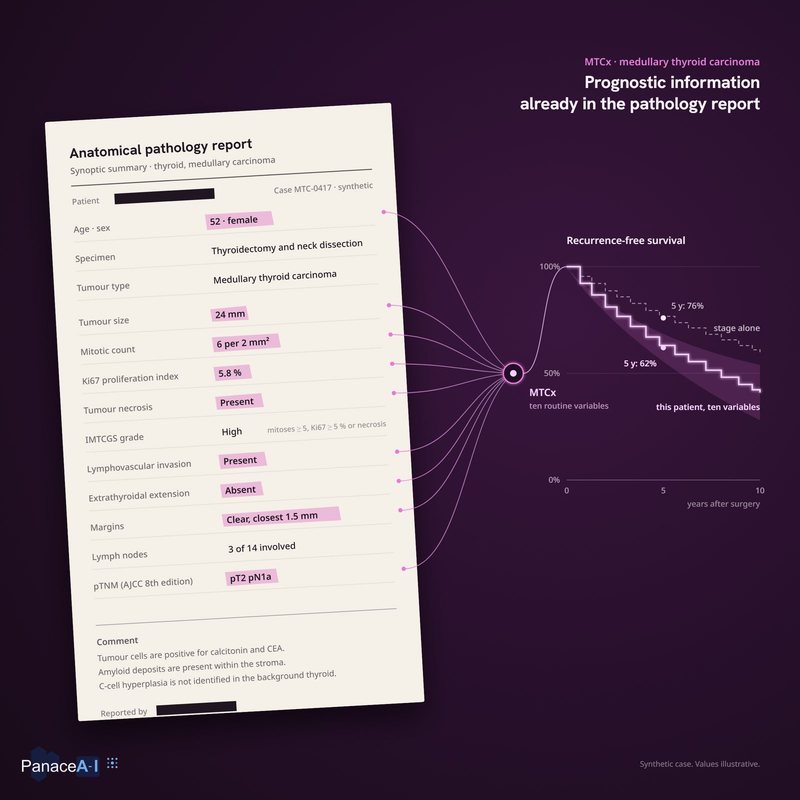
A tilted cream pathology report on a dark aubergine ground, with ten of its entries highlighted in pink and joined by fine lines to a single point, which opens into a stepped survival curve at the right.
Ten variables already in a routine pathology report combine into one patient’s recurrence-free survival curve. Illustration; the case is synthetic.

Mesothelioma survival

Diffuse pleural mesothelioma

Estimates
Survival.
For
Clinicians caring for people with diffuse pleural mesothelioma.
Uses
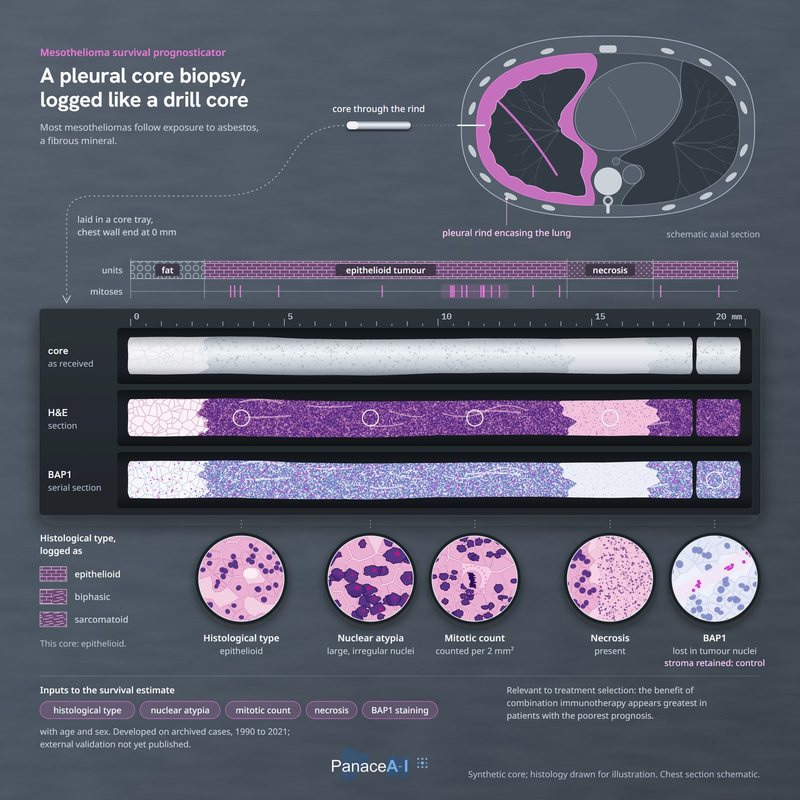
Routinely reported pathology features (histological type, nuclear atypia, mitotic count, necrosis and BAP1 staining) with age and sex. It builds on the Mesothelioma Weighted Grading Scheme.
Evidence
Developed from thirty years of Royal North Shore Hospital pathology archives: 369 patients, 1990 to 2021 (AUC 0.75, C-index 0.67). Validated on this single institution’s archive; external validation has not yet been published.
Paper
A novel prognostic nomogram for predicting survival in diffuse pleural mesothelioma Pathology, 2023;55(4):449-455. PubMed 36842876.

Open the calculator: mesothelioma survival panacea.shinyapps.io/Mesothelioma

A slate grey plate: a chest in cross section with the pleura in pink at the top, and below it a core tray holding three strips of the same biopsy with a ruler in millimetres, followed by five round close-ups of the tissue.
A pleural core biopsy logged like a drill core, with the pathology features the survival estimate uses. Illustration; the core is synthetic and the chest section schematic.

PolypRisk AI

Malignant colorectal polyps

Estimates
The risk of residual or nodal disease, and of later recurrence.
For
Clinicians caring for people whose removed colorectal polyp turns out to be malignant.
Uses
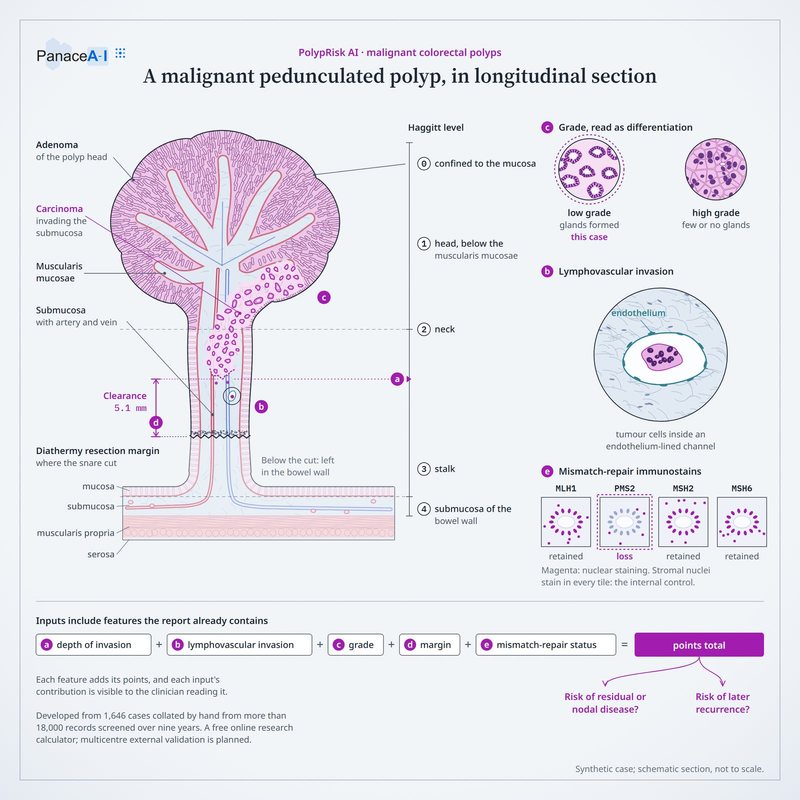
Features a pathology report already contains, including depth of invasion, lymphovascular invasion, grade, margin and mismatch-repair status.
Evidence
Developed on 1,646 cases, collated by hand from more than 18,000 Queensland records screened over nine years (AUC 0.76). Multicentre external validation is planned.
Paper
Development of a novel malignant colorectal polyp prognostic nomogram ANZ Journal of Surgery, 2025;95(6):1190-1197. DOI 10.1111/ans.19384.

Open the calculator: PolypRisk AI panacea.shinyapps.io/PolypRisk_AI

An anatomical drawing on a pale ground of a mushroom-shaped polyp cut lengthwise on its stalk, in pink and violet, with labels for its layers and levels, small panels for grade, vessel invasion and immunostains, and a row of five inputs adding into a points total.
A malignant stalked polyp in longitudinal section, labelled with the features the model uses. Illustration; a schematic section, not to scale.